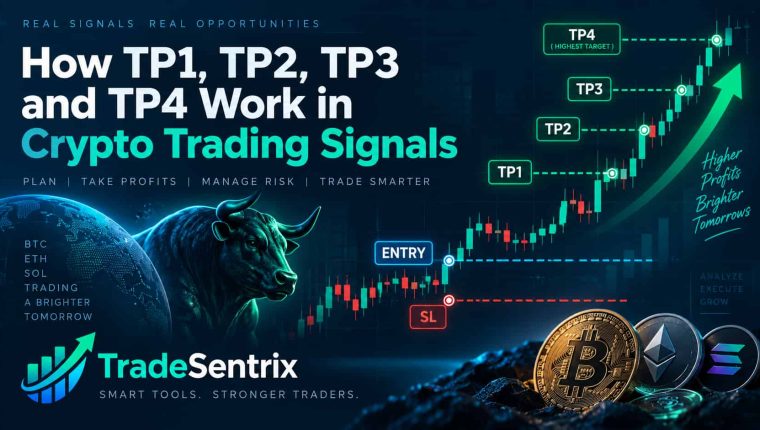

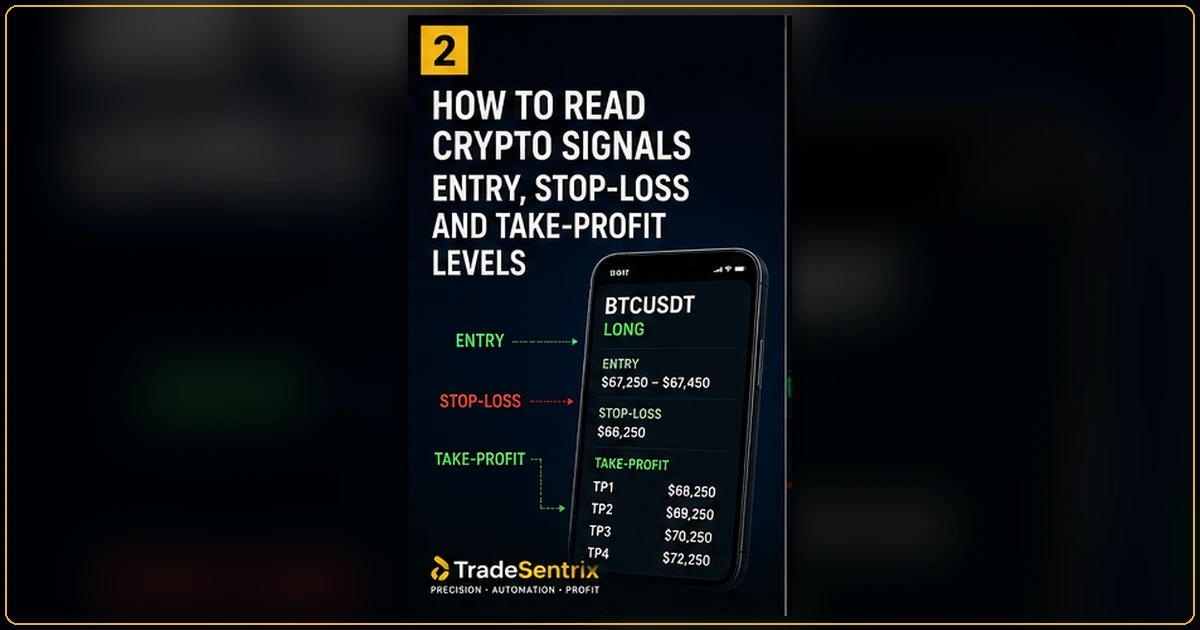
A crypto signal becomes useful only when the trader understands every level and knows what action is required. The three most important components are the entry, the stop-loss and the take-profit targets. Together they define the trade plan before emotion takes control.
How to Read Crypto Signal Entry and Start with the symbol and market type
Confirm the exact market first. BTCUSDT spot, BTCUSDT perpetual futures and coin-margined Bitcoin contracts can have different prices, fees and risk mechanics. The signal should identify the intended instrument clearly.
Also confirm the direction:
- BUY or LONG: the setup expects price to rise after entry.
- SELL or SHORT: the setup expects price to fall after entry.
What is the entry?
The entry is the price at which the planned trade becomes active. It may be one number or a range.
Exact entry
An exact entry could be shown as BTCUSDT BUY at 68,400. Traders may use a limit order at that price or wait for confirmation near it.
Entry zone
A zone could be shown as 68,200–68,500. The zone provides execution flexibility, but the position size should still be calculated using the actual fill price.
For a BUY, an entry near the bottom of the zone usually offers a smaller stop distance than an entry at the top. For a SELL, the opposite can be true. Never assume every price inside a wide zone has identical risk.
What does signal validity mean?
A signal is valid only while its original structure remains intact. It may become invalid when:
- the stop-loss is reached;
- the first or final target is already completed;
- price moves too far away from entry;
- the provider marks it cancelled or expired;
- market structure changes before entry.
Always check the publication time and current market price. A technically correct signal can become a poor entry if received or opened too late.
How to understand the stop-loss
The stop-loss is the price that limits the trade when the setup is wrong. For a BUY, it normally sits below the entry. For a SELL, it normally sits above the entry.
The stop should be related to market structure rather than selected randomly. Examples include below a confirmed support, above a resistance, beyond a swing high or low, or outside a volatility range.
A wider stop is not automatically safer. It increases the loss per unit and therefore requires a smaller position. A tighter stop reduces distance but may be more vulnerable to ordinary volatility.
How TP1, TP2, TP3 and TP4 work
Take-profit levels are predefined prices where part or all of the position may be closed.
- TP1: the nearest objective and usually the most conservative.
- TP2: a secondary objective that may capture a larger move.
- TP3 and TP4: extended targets for strong continuation.
Traders may scale out—for example, closing part at TP1 and another part at TP2. The remaining quantity can be protected with a tighter stop. The exact allocation should be decided before entering.
Calculate risk before calculating profit
Suppose a BUY entry is 100 and the stop is 98. The risk distance is 2%. If TP1 is 103, the potential move to TP1 is 3%, creating a gross reward-to-risk ratio of 1.5 to 1 before fees and slippage.
Leverage does not improve the underlying ratio. It magnifies both the gain and the loss. The setup remains a 2% stop and 3% target in market-price terms.
Use position size, not hope, to control risk
A simple approach is:
- Choose the maximum account amount you are willing to lose.
- Measure the percentage distance from entry to stop.
- Calculate a position size that keeps the stop loss within that amount.
- Reduce size further when volatility or execution risk is high.
For more detail, read Binance Futures risk management: leverage, position size and stop loss.
Common mistakes when following a signal
Entering after a large move
When price has moved close to TP1, the remaining upside may be small while the original stop remains far away.
Moving the stop farther away
This converts a controlled loss into an unknown loss. If the setup is invalidated, accept the planned outcome.
Using the same size on every trade
Different stop distances require different position sizes. Fixed position value can produce inconsistent account risk.
Confusing a wick with a candle close
Some strategies use intrabar touches; others require candle-close confirmation. Follow the stated rule consistently.
Ignoring fees and slippage
Short-term targets can be affected materially by trading fees, spread and fast-market execution.
How to verify a TradeSentrix signal
Open the signal on the TradeSentrix website and confirm the symbol, action, timeframe, entry, stop, targets, publication time and current status. Do not rely only on a forwarded Telegram screenshot.
Relevant pages include the crypto signals overview and Binance Futures signals.
Frequently asked questions
What happens if price touches the stop with a wick?
That depends on the signal’s execution rule and the exchange order type. If the stop order is triggered by the selected price source, the position may close even when the candle later recovers.
Can I enter at any point inside the entry zone?
You can, but the exact fill changes your stop distance and reward-to-risk ratio. Recalculate before entering.
Should the stop move to break-even after TP1?
It can reduce downside, but moving too early may close a valid trade during a normal pullback. Use a documented rule instead of changing it emotionally.
What if the signal has no stop-loss?
Treat that as a serious risk warning. A futures trade without a defined invalidation level can expose the account to uncontrolled loss.
Study live signal structure on TradeSentrix Crypto Signals.
Risk notice: Crypto assets and leveraged futures are volatile. This article is educational and does not provide financial advice, a guarantee of profit, or a recommendation to open a position. Always verify signal details, use risk controls, and trade only with funds you can afford to lose.