
What Is Funding Rate in Binance Futures and Why Does It Matter?
Perpetual crypto futures do not have a fixed expiry date. That makes them convenient for active traders, but it also creates a challenge: the futures price can drift away from the underlying spot market.
Funding is one of the mechanisms used by perpetual futures markets to encourage the contract price to remain reasonably aligned with the underlying market.
For a trader, funding matters because it can create an additional cost or credit while a position remains open. It does not change whether the original signal was technically correct, but it can affect the real result of holding a leveraged futures position.
What is a funding rate?
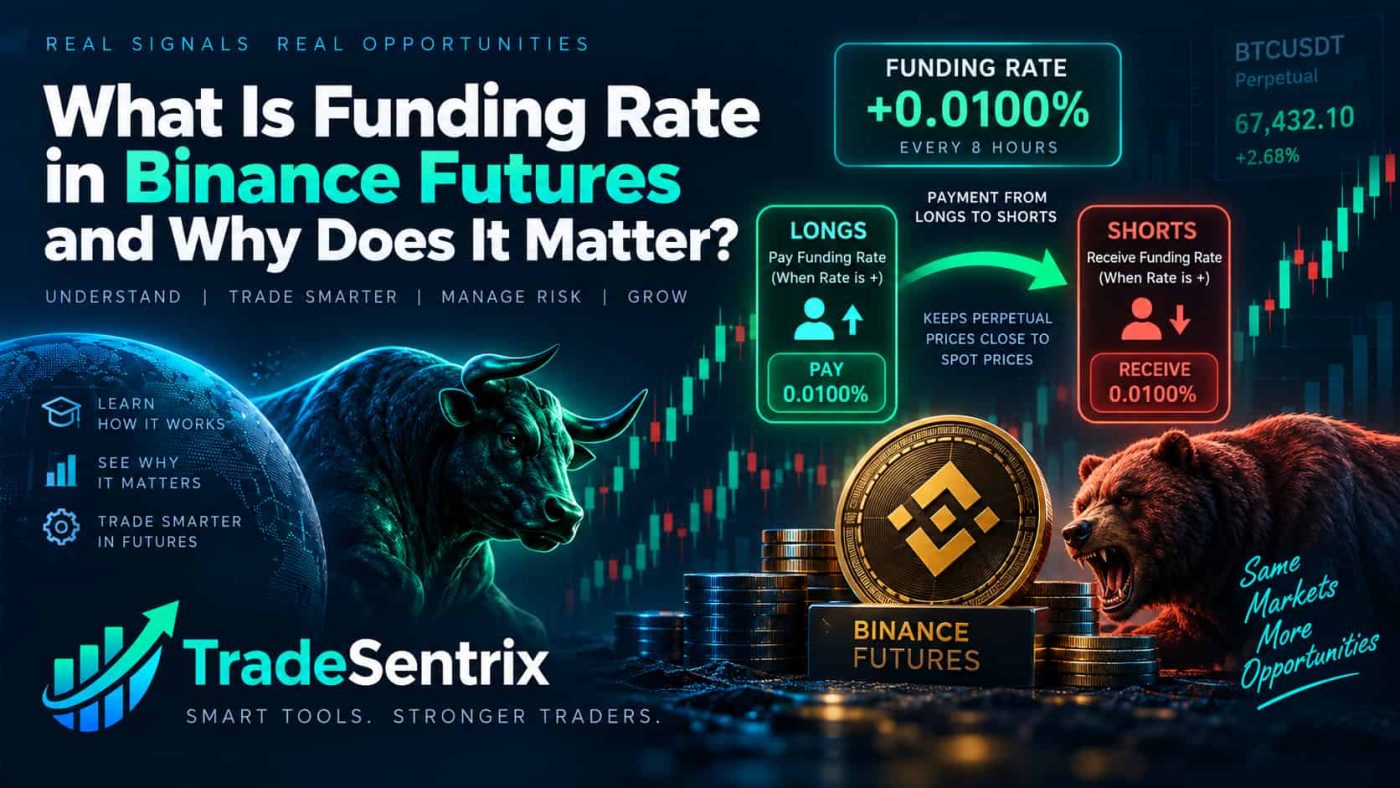
The funding rate is a periodic payment exchanged between traders holding long and short perpetual futures positions.
Depending on the rate and the exchange’s rules:
- when funding is positive, long positions generally pay short positions;
- when funding is negative, short positions generally pay long positions.
The exchange facilitates the transfer, but funding is generally paid between market participants rather than being a normal trading fee collected in the same way as an entry commission.
The exact calculation, timing and applicable rate depend on the contract and exchange conditions at that moment.
Why does funding exist?
A perpetual futures contract has no expiry date, so there is no automatic settlement event forcing its price back toward spot.
Funding creates an incentive mechanism.
If perpetual futures are trading above spot and the market becomes heavily long, positive funding can make holding long positions more expensive while short positions receive funding. This can encourage more balanced positioning.
If futures trade below spot and positioning becomes heavily short, negative funding can create the opposite incentive.
Funding does not guarantee that futures and spot prices remain identical. It simply helps reduce persistent divergence.
Positive funding does not automatically mean “sell”
A common mistake is to treat positive funding as a direct bearish signal.
Positive funding often indicates that long demand is stronger than short demand, but a strong bullish market can remain positively funded for an extended period while price continues upward.
Likewise, negative funding does not automatically mean price must rise.
Funding should be treated as context. It can show how crowded positioning may be, but it should be combined with price structure, trend, momentum, support, resistance and risk management.
How funding affects a long position
Assume a trader holds a long perpetual futures position when the funding rate is positive. If the position remains open when the funding event occurs, the trader may pay funding based on the contract’s funding calculation.
A short-duration trade that opens and closes between funding events may have little or no funding impact. A position held across several funding periods may accumulate more cost.
This matters when expected profit is small. A strategy targeting very small moves can have a meaningful portion of its result reduced by fees, slippage and funding.
How funding affects a short position
When funding is positive, a short position may receive funding rather than pay it. When funding is negative, the short may be the paying side.
Receiving funding does not make a bad short setup good. If price moves strongly against the position, the market loss can easily exceed any funding received.
Funding should never replace a Stop Loss or become the main reason for holding an invalidated trade.
Funding rate and leverage
Funding is linked to the position’s notional exposure, not simply the amount of margin deposited.
That means leverage can make funding more significant relative to the trader’s actual margin.
For example, two traders may each allocate the same margin amount, but the trader using higher leverage controls a larger notional position and may therefore experience a larger funding payment or credit.
This is another reason leverage should be treated as an exposure tool rather than as a way to increase signal accuracy.
A simple funding example
Suppose a trader holds a $10,000 notional long position and the applicable funding rate for the event is 0.01%.
The simplified funding amount would be:
$10,000 × 0.01% = $1
If the trader is on the paying side, approximately $1 is paid for that funding event under this simplified example.
If the position remains open for multiple funding periods, the total can accumulate. Actual exchange calculations may use specific mark prices, timing rules or contract formulas, so traders should check the live contract information rather than assuming every funding event is identical.
Why funding matters for signal followers
A signal normally defines Entry, Stop Loss and Take-Profit levels. Those levels describe price movement, but an individual trader’s account result can differ because of execution costs.
Differences can come from:
- entry slippage;
- exit slippage;
- trading fees;
- funding payments;
- different leverage;
- different position size;
- different exit target.
Therefore public signal performance and personal account P/L are not always identical.
A transparent platform should distinguish market-level signal outcomes from claims about guaranteed realized profit.
Check funding before holding a position for a long time
Funding is particularly relevant when:
- the trade may remain open for many hours or days;
- the rate is unusually elevated;
- the position size is large;
- leverage is high;
- expected target distance is relatively small.
A short scalp may be affected mainly by fees and slippage, while a multi-day futures trade may require more attention to funding.
Can extreme funding signal crowded positioning?
An unusually high positive funding rate can indicate that long positioning is crowded. An unusually negative rate can indicate heavy short positioning.
Crowded positioning can matter because rapid liquidations may amplify price moves when the market reverses.
However, extreme funding should not be traded mechanically. Crowded markets can remain crowded longer than expected, and price can continue trending despite expensive funding.
Use funding as one input among several.
Funding and liquidation risk are different
Funding cost and liquidation are separate concepts.
Funding is a periodic payment or credit. Liquidation occurs when margin conditions deteriorate enough that the exchange closes the leveraged position according to its risk rules.
A trader can have a low funding cost and still face high liquidation risk if leverage is excessive. Likewise, a well-margined position can pay funding for an extended period without approaching liquidation.
Read the TradeSentrix Binance Futures Risk Management guide for more detail on leverage, position size, margin modes and Stop Loss planning.
Funding and isolated versus cross margin
Funding can affect both isolated and cross-margin positions, but the way account risk is contained differs.
With isolated margin, the position uses a defined margin allocation. With cross margin, available account collateral can support the position more broadly, subject to the exchange’s rules.
Funding should not be the reason to select one margin mode over another. Margin mode is primarily an account-risk decision.
Funding should not change a valid Stop Loss
Suppose a trader is long, funding is positive and the trade has moved against the setup. It can be tempting to widen the Stop Loss to avoid closing before the next market move.
That is poor risk discipline.
The Stop Loss should be based on where the market thesis becomes invalid. Funding is an execution cost, not a reason to ignore technical invalidation.
If the trade no longer makes sense, holding it only because funding might later change is not a structured strategy.
How funding fits into a complete futures checklist
Before opening a futures position, consider:
- Is the signal still valid at the current price?
- What is the distance from Entry to Stop Loss?
- What is the position size based on the maximum acceptable loss?
- What leverage is being used?
- What are the trading fees?
- Is a funding event likely while the trade is open?
- Is the funding rate unusually high or low?
- Does the expected reward still justify the total risk and costs?
Funding is only one part of the checklist, but ignoring it can make real performance different from the chart-level expectation.
Funding and automated futures trading
Automated systems can place and manage futures positions consistently, but automation does not remove funding cost.
An automated strategy should still account for how long positions remain open, how frequently signals trade and whether the expected edge is large enough to absorb fees, slippage and funding.
TradeSentrix’s article on Automated Binance Futures Trading explains additional execution risks such as API permissions, protective orders and duplicate-trade controls.
Common funding-rate mistakes
Assuming positive funding guarantees a drop
Positive funding can persist during strong uptrends.
Assuming negative funding guarantees a rally
Heavy short positioning can remain profitable if the downtrend continues.
Ignoring funding on large leveraged positions
A small percentage can become more noticeable when notional exposure is large.
Holding an invalid trade to receive funding
Funding received is usually small compared with the potential loss from a large adverse price move.
Comparing personal P/L directly with signal target movement
Your final result may include fees, slippage and funding that are not represented by the raw difference between Entry and target prices.
Frequently asked questions
How often is funding paid?
The schedule depends on the exchange and contract. Traders should check the live contract details because timing and rates can change.
Is funding the same as a trading fee?
No. Trading fees are generally charged for order execution, while funding is a periodic transfer associated with holding perpetual futures positions.
Can I avoid funding?
A position that is not open at the relevant funding time will generally not participate in that event, subject to the exchange’s rules. Do not open or close trades solely to avoid a small funding payment without considering market risk and trading fees.
Does high funding mean the market is overbought?
Not necessarily. It can indicate crowded long positioning, but price can continue rising. Funding should be combined with market structure and other evidence.
Does TradeSentrix guarantee a user’s final P/L after funding?
No. Signal outcomes describe market-level target and Stop Loss progression. Individual results can differ because of entry timing, leverage, fees, funding, slippage and exit decisions.
Final takeaway
Funding rate is an important part of perpetual futures trading because it can create a real cost or credit while a position remains open. It can also provide useful context about how aggressively the market is positioned long or short.
But funding is not a standalone trading signal. Use it together with market structure, disciplined position sizing, defined Stop Loss levels and realistic profit targets.
For structured market setups, review the TradeSentrix Binance Futures Signals page and the educational guide on crypto trading signals.
Risk notice: Leveraged crypto futures involve substantial risk. Funding rates can change, exchange rules can change and market losses can exceed funding credits. This article is educational and does not provide personalized financial advice or guarantee profit.
Featured image prompt
Create a professional educational graphic explaining perpetual futures funding: long traders and short traders on opposite sides, a subtle funding-payment arrow between them, candlestick chart in the background, premium dark exchange-dashboard style, clear “Funding Rate” title, no guaranteed-profit visuals, 16:9 landscape.