
XRPUSDT Signals How to Evaluate XRP Futures Setups in 2026
XRPUSDT is an actively traded crypto futures market that can move quickly during broad market volatility, asset-specific news and changes in speculative positioning. That speed makes XRP attractive to short-term traders, but it also means a directional alert without clear risk levels is not enough.
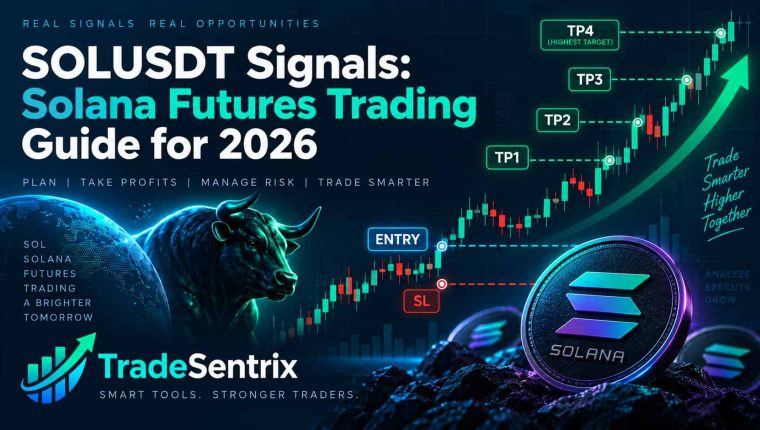
A useful XRPUSDT signal should define the direction, entry, Stop Loss, profit targets and publication time. The trader should then evaluate whether the setup remains valid at the moment it is received.
TradeSentrix currently includes XRPUSDT among its supported crypto markets. The platform uses structured signal fields so traders can review the setup rather than relying on a simple “buy” or “sell” message.
Start with XRP’s own market structure
The first question is whether XRPUSDT is trending, ranging or transitioning between the two.
A bullish structure generally contains higher highs and higher lows. A bearish structure generally contains lower highs and lower lows. In a range, price repeatedly reacts between support and resistance without establishing a sustained directional sequence.
For short-term futures trading, the local XRP chart should remain the primary source of confirmation. Bitcoin and the broader market can influence XRP, but a strong XRPUSDT setup should not exist only because BTC is moving in the same direction.
Map support and resistance before looking for an entry
Support and resistance help identify where a setup has room to develop.
For a BUY idea, useful questions include:
- Is price holding above a confirmed support zone?
- Is there enough room to the next resistance for TP1 or TP2?
- Has a breakout level been retested successfully?
- Is the Stop Loss beyond a meaningful invalidation point rather than inside normal noise?
For a SELL idea, reverse the logic. A failed rally into resistance or a confirmed breakdown followed by a weak retest can provide a cleaner structure than selling randomly in the middle of a range.
Because crypto levels behave as zones rather than exact lines, a single wick through support or resistance should not automatically be treated as a confirmed breakout.
Use candle confirmation instead of reacting to every wick
XRP can produce fast intrabar moves. A price briefly trading above resistance does not always mean the breakout is valid.
Confirmation methods may include:
- a candle close beyond the level;
- a breakout followed by a successful retest;
- a clear shift in swing structure;
- stronger momentum in the breakout direction;
- volume expansion when price leaves a range.
Waiting for confirmation may produce a slightly less attractive entry, but it can reduce the number of trades entered during false breakouts.
Watch volatility before sizing the position
A Stop Loss that looks large in percentage terms may be normal during a volatile XRP session, while a tight stop may sit inside ordinary candle noise.
The correct response to higher volatility is not automatically to remove the stop. Instead, position size should be adjusted so that the monetary loss at the Stop Loss remains within the trader’s risk limit.
For example, if an XRP setup requires a wider invalidation level, the trader can use a smaller position. Leverage should not be used to compensate for a wide stop.
Read the TradeSentrix Binance Futures Risk Management guide for a detailed explanation of leverage, position size and Stop Loss planning.
Momentum can help confirm direction
Momentum tools can help evaluate whether price is accelerating in the direction of the setup or losing strength near an important level.
However, momentum should be interpreted in context. A strong oscillator reading by itself does not prove that price will continue. During a trend, an indicator can remain elevated or depressed for longer than expected.
Momentum is most useful when combined with structure. For example, a BUY setup may be stronger when price forms a higher low, reclaims resistance and momentum turns upward at the same time.
Volume can help distinguish a real breakout from a weak move
A breakout supported by increased trading activity may have more participation than one that drifts through a level on low volume.
For XRPUSDT, traders can compare current volume with recent candles rather than looking only at the absolute number. A sudden expansion in volume around a breakout, rejection or liquidity sweep may provide useful context.
Volume is not a guarantee. High-volume moves can also mark exhaustion or liquidation events. The key is to evaluate where the volume occurred and what price did immediately afterward.
Build the complete XRPUSDT signal plan
Before entering, a structured XRP futures setup should answer:
- Is the current structure bullish, bearish or ranging?
- Which support, resistance or breakout level creates the opportunity?
- What confirms the entry?
- Where is the setup invalidated?
- Where are TP1, TP2, TP3 and TP4 relative to nearby market structure?
- Does the reward available justify the Stop Loss distance?
- Is the signal still fresh at the current price?
A signal that cannot answer these questions is difficult to audit after the fact.
Illustrative XRPUSDT BUY setup
Assume XRPUSDT has been trending upward and pulls back toward a previous resistance level that has become support. Price rejects the zone, forms a higher low and then closes above a short-term consolidation.
A structured BUY signal could use the breakout or retest as the entry, place the Stop Loss below the higher low, and use prior swing highs or measured resistance levels for TP1 through TP4.
The setup becomes weaker if price immediately falls back below the reclaimed level or breaks the higher low.
Illustrative XRPUSDT SELL setup
Assume XRPUSDT is making lower highs and lower lows. Price rallies into former support that now acts as resistance, fails to reclaim it and closes back below the local range.
A SELL setup could use the failed retest as entry confirmation, place the Stop Loss above the rejection swing and define targets at lower support zones.
The idea is invalidated if price reclaims resistance and holds above it.
These examples explain structure only. They are not live trade recommendations.
Do not chase an XRP signal after the move has already happened
Late entry is especially dangerous in volatile markets.
Suppose a BUY signal was published near 1.00 with TP1 at 1.03 and the current price is already 1.029. Entering at that point leaves very little distance to TP1 while the original Stop Loss may remain much farther away.
The original signal can still be valid historically while the new entry is unattractive for a late trader.
Always compare current price with Entry, TP1 and Stop Loss before acting.
How TP1–TP4 should be interpreted on XRPUSDT
Multiple targets show how far the move progressed.
If XRP reaches TP1 and TP2 but later reverses into the Stop Loss, a transparent history should preserve all three events. The signal did reach the first two objectives, and it also later hit the stop.
This is why target progression is more informative than reducing every trade to a single green or red label.
Read How TP1, TP2, TP3 and TP4 Work in Crypto Trading Signals after publishing the first article in this batch.
XRPUSDT and broader crypto market context
XRP can move independently, but broad market conditions still matter. During a strong market-wide selloff, an XRP long setup may face additional pressure. During a broad risk-on move, bearish setups may require stronger confirmation.
Use Bitcoin and total crypto sentiment as context, not as a substitute for XRP’s own structure.
A good signal should remain explainable from the XRPUSDT chart itself.
Common XRP futures mistakes
Using excessive leverage
High leverage magnifies both profit and loss. It also reduces the amount of adverse movement an account can tolerate before margin becomes stressed.
Entering in the middle of a range
Range centers often provide poor reward-to-risk because both support and resistance are relatively close.
Widening the Stop Loss after entry
Moving the stop farther away because the trade is losing changes the original risk plan and can turn a controlled loss into a much larger one.
Treating every breakout as real
XRP can quickly wick beyond a level and return. Confirmation helps reduce false-breakout entries.
Ignoring signal age
A good setup can become a poor trade if price has already moved through one or more targets before the trader enters.
How to evaluate historical XRPUSDT signals
When reviewing past XRP signals, look at more than one percentage.
Useful questions include:
- How many closed XRPUSDT signals are in the sample?
- How often was TP1 reached before SL?
- How often did TP2, TP3 and TP4 follow?
- Were all Stop Loss events retained?
- Were publication timestamps recorded before the market move?
- How did the signals perform in trending and ranging conditions?
The TradeSentrix guide on evaluating crypto signal accuracy explains why consistent definitions and complete loss reporting matter.
Frequently asked questions
Are XRPUSDT signals guaranteed to work?
No. XRP futures remain uncertain and can reverse quickly. A signal is a structured market plan, not a guaranteed outcome.
Is XRP more volatile than Bitcoin?
Volatility changes over time. XRP can experience sharp percentage moves, so traders should measure current volatility rather than relying on a permanent assumption.
Should XRP signals depend on BTC direction?
Bitcoin can provide useful market context, but XRPUSDT should be evaluated primarily from XRP’s own structure, momentum, volatility and levels.
Can XRPUSDT use multiple profit targets?
Yes. A structured signal can use TP1 through TP4 to track progressive objectives.
Where can I review TradeSentrix crypto signals?
Use the TradeSentrix Crypto Signals page and the Binance Futures Signals page to review the platform’s structured signal format.
Final takeaway
The best way to evaluate an XRPUSDT signal is to combine structure, key levels, confirmation, volatility and disciplined risk management. The purpose of the signal is not to remove uncertainty; it is to define the trade plan clearly enough that the trader can measure risk before acting and review the result afterward.
Treat the Entry, Stop Loss, TP1–TP4 and publication time as one complete package. If any of those elements no longer make sense at the live price, the trader should reconsider the setup rather than chasing it.
Risk notice: XRP and leveraged crypto futures are volatile and can result in substantial loss. This article is educational and does not provide personalized financial advice, a guarantee of profit or a recommendation to open a position.
Featured image prompt
Create a professional financial education featured image focused on XRPUSDT futures: dark crypto trading interface, XRP symbol, candlestick chart, clearly marked support, resistance, Entry, Stop Loss and TP1–TP4 levels. Clean institutional style, no exaggerated profit graphics, 16:9 landscape.